Short answer "Folds" means two different things, and the difference is bigger than any spec sheet admits. Some folding treadmills fold flat and slide under a bed. Others fold the running deck up vertically and stay standing at roughly the height of the machine itself. Both are honestly described as folding. Only one gives you the floor back.
The two kinds of fold
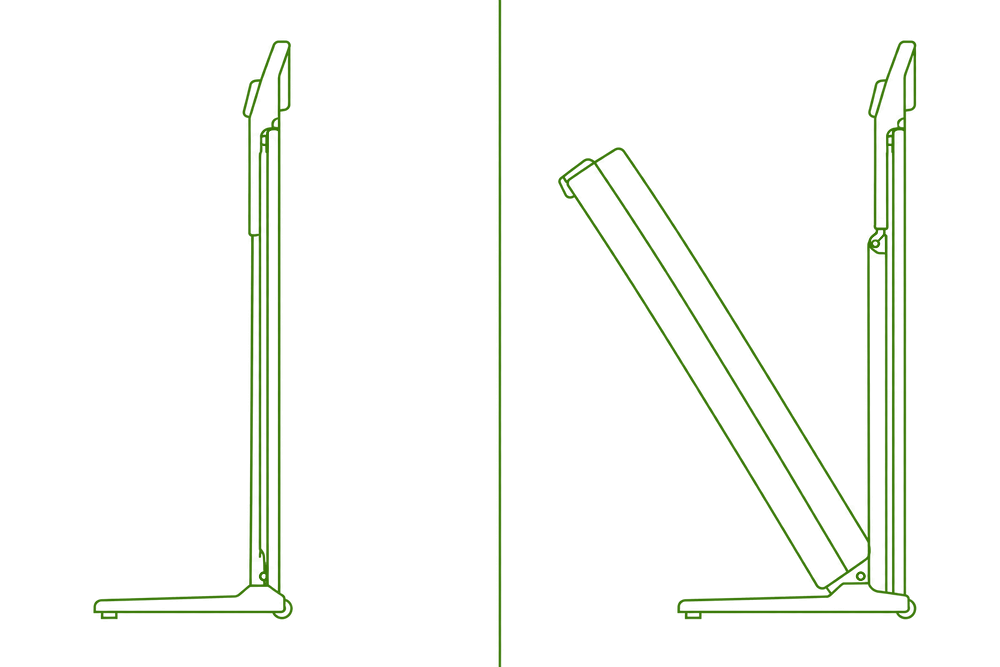
Flat fold hinges the deck up and back down to lie almost flush with the base. Folded depth drops to the width of the base itself, typically 25 to 30cm — genuinely thin enough to slide under a low bed or sofa.
Lift fold, sometimes called a fold-up deck, tilts the running deck up to stand vertically against the upright posts. It is a smaller footprint than running position, and it is nothing like flat: the folded machine can still be well over a metre deep, because the deck itself has not gone anywhere, it has just changed angle.
Neither is better in the abstract. A lift-fold machine is usually the sturdier build, because the mechanism that survives a heavier deck and a stronger frame is not the same one that folds flush. But if the reason you want folding is a small room, the two types solve completely different problems.
What the machines we have sourced actually do when folded
| Machine | Fold type | Folded depth | Weight | Evidence |
|---|---|---|---|---|
| Toputure Folding Treadmill | Flat folding | 11.4 cm | 21.6 kg | Manufacturer stated, Retailer listing, checked 23 Sept 2026 |
| UREVO 2-in-1 Foldable Treadmill | Flat folding | 12 cm | 18.8 kg | Manufacturer stated, Retailer listing, checked 22 Sept 2026 |
| JLL Pegasus Connected Folding Treadmill | Folds flat | 15 cm | 41 kg | Manufacturer stated, Manufacturer spec, checked 18 Sept 2026 |
| JTX RunRise | Flat folding | 25 cm | 67 kg | Manufacturer stated, Manufacturer spec, checked 18 Sept 2026 |
| JTX SlimLine | Flat folding | 26.5 cm | 43 kg | Manufacturer stated, Manufacturer spec, checked 18 Sept 2026 |
| Decorcn Foldable Treadmill | Hydraulic incline fold | 94.5 cm | 49 kg | Manufacturer stated, Retailer listing, checked 23 Sept 2026 |
| Reebok Jet 100z | Folds upright | 98 cm | 71 kg | Manufacturer stated, Retailer listing, checked 19 Sept 2026 |
| NordicTrack Commercial 1750 | Folds upright | 112 cm | 140 kg | Manufacturer stated, Retailer listing, checked 18 Sept 2026 |
| Horizon 5.0AT | Folds upright | 116 cm | 81.5 kg | Manufacturer stated, Retailer listing, checked 18 Sept 2026 |
| JTX Sprint-7 | Fold-up deck | 120 cm | 85 kg | Manufacturer stated, Manufacturer spec, checked 18 Sept 2026 |
| JTX Sprint-8 Pro | Fold-up deck | 132 cm | 117 kg | Manufacturer stated, Manufacturer spec, checked 18 Sept 2026 |
| Echelon Stride Sport | Folds | not established | 48.5 kg | Manufacturer stated, Manufacturer spec, checked 18 Sept 2026 |
| ProForm Carbon TL | Foldable | not established | 81 kg | Manufacturer stated, Retailer listing, checked 18 Sept 2026 |
If folded depth is the figure that decides it for you, the finder filters every machine we hold a record for on that and on deck length, incline and stated maximum user weight, and shows the ones that do not publish a figure rather than dropping them.
The gap in that table is the point: 5 machines fold to under 50cm, 6 fold to well over a metre. Nothing sits in between.
Before you assume folding solves your space problem
- Measure the folded depth, not the running footprint. A brochure photo of a folded machine tells you nothing about which type it is.
- Ask what "folds" means for this specific model before assuming either type. The word alone does not tell you.
- Weight matters as much as depth. A flat-folding machine light enough to slide under furniture is genuinely portable. A lift-fold machine at 80kg plus does not move easily even folded.
- Unfolding it is friction. Any machine that has to be unfolded and set up each session gets used less than one left standing. If you would actually leave it out, folding capability may not matter to you at all — see what actually decides whether a treadmill suits you.
What we have not established
We have not measured how long unfolding actually takes on any of these machines, or how the fold mechanism holds up after months of daily use. Both would be useful and neither is something we can respect the evidence rules and simply state. How we review.
Related: weight ratings and structural limits ·manual vs motorised