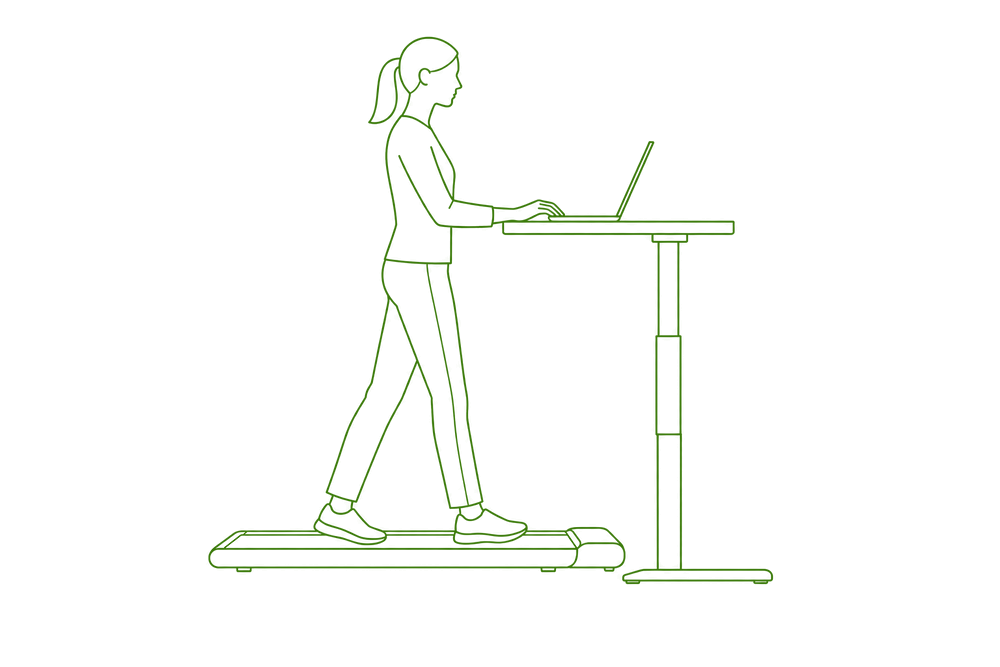
A walking pad is a flat, handlebar-free belt designed to go under a desk or a sofa. It is not a small treadmill, and the difference matters: no handrails, a shorter and narrower belt, a much lower top speed, and a motor sized for walking rather than running. If you intend to run, or you want something to hold on to, you want a treadmill instead.
What you are actually buying
The appeal is specific and it is not fitness in the usual sense. A walking pad lets you add a few thousand steps to a working day you were going to spend sitting down anyway. That is the job it does well. Used that way, at two or three kilometres an hour while you answer email, it works and people keep using them.
Bought as a cheap substitute for a treadmill, it disappoints, because it is not one.
The specifications that decide it
Top speed, and be honest about it
Most walking pads top out around 6 km/h. Without handrails, and on a belt that short, the top of that range is faster than it sounds. If you want to jog at all, this is the wrong category.
Noise, which is the reason most get returned
The point of a walking pad is using it while doing something else, usually something involving a microphone. A pad you cannot take a call over is a pad you stop using. Manufacturer decibel figures are measured in ways they rarely disclose and we do not treat them as comparable; where a figure has no stated method we mark it accordingly. Manufacturer stated, Manufacturer spec, checked 18 Sept 2026
Incline, which is newer than most listings suggest
Fixed-incline and adjustable-incline pads both exist now, and incline raises effort a lot at walking speed. It also raises the height of the deck, which matters if you are trying to fit under a standing desk at a comfortable height. Measure the space, including the deck thickness, before you buy on incline.
Deck height and desk fit
You are adding several centimetres under your feet. A standing desk that was right for you at standing height is not right for you standing on a pad, and not every desk raises far enough. This is the most common practical mistake and it is entirely avoidable with a tape measure.
Maximum user weight and belt width
Lower than treadmills across the board, and the belt is narrower. Without handrails, belt width is what decides whether it feels secure rather than whether it fits.
Every walking pad we have sourced, against those specifications
| Machine | Top speed | Max user weight | Incline | Evidence |
|---|---|---|---|---|
| DeerRun Q2 Urban Plus | 6 km/h | 136 kg | 7% | Manufacturer stated, Retailer listing, checked 18 Sept 2026 |
| JTX MoveLight | 6 km/h | 100 kg | None | Manufacturer stated, Manufacturer spec, checked 18 Sept 2026 |
| UREVO SpaceWalk Lite | 6 km/h | not established | not established | Manufacturer stated, Manufacturer spec, checked 18 Sept 2026 |
| WalkingPad C2 | 6 km/h | 100 kg | not established | Manufacturer stated, Manufacturer spec, checked 18 Sept 2026 |
| WalkingPad P1 | 6 km/h | 100 kg | not established | Manufacturer stated, Manufacturer spec, checked 18 Sept 2026 |
5 walking pads sourced with checkable specifications so far. Desk-fit specifically (deck height, folded depth, weight to move) is covered on under desk treadmill instead of repeated here.
Where a walking pad goes wrong
- You wanted to run. Buy a treadmill.
- You wanted handrails. Some pads have a removable handlebar, which makes them a small treadmill with the compromises of both.
- It lives under the sofa. Anything that has to be dragged out gets used for a fortnight. The ones that get used live where they are used.
- You are above someone. Walking impact through a floor is still impact.
Related
- Treadmills — if you want to run, or want handrails.
- Running costs — the same arithmetic as a treadmill, with whatever your own pad's rating plate says.
- How we review — why every figure here carries a source and a date.